Case archive · Verification & Validation
Every number can be recomputed
These are not customer stories — they are kernel verification records. Model files, analysis settings, key results and errors are public for every case. Download the model and recompute it yourself; if the numbers do not match, that is on us.
- Models openEvery case ships with its full Tcl model file — elements, materials, analysis settings — rerunnable as-is in OpenSees 3.7.2.
- Checked against analytical solutionsWherever an analytical solution exists, we list the analytical value, the computed value and the relative error — no "good agreement" hand-waving.
- Failures recorded tooNon-converged and wrong runs stay on record — software that hides its failed cases does not deserve trust.
- Version-boundEvery record states the solver version; after a kernel upgrade everything is rerun, and old results never pose as new ones.
CASE-A
Single-storey portal frame · nonlinear pushover
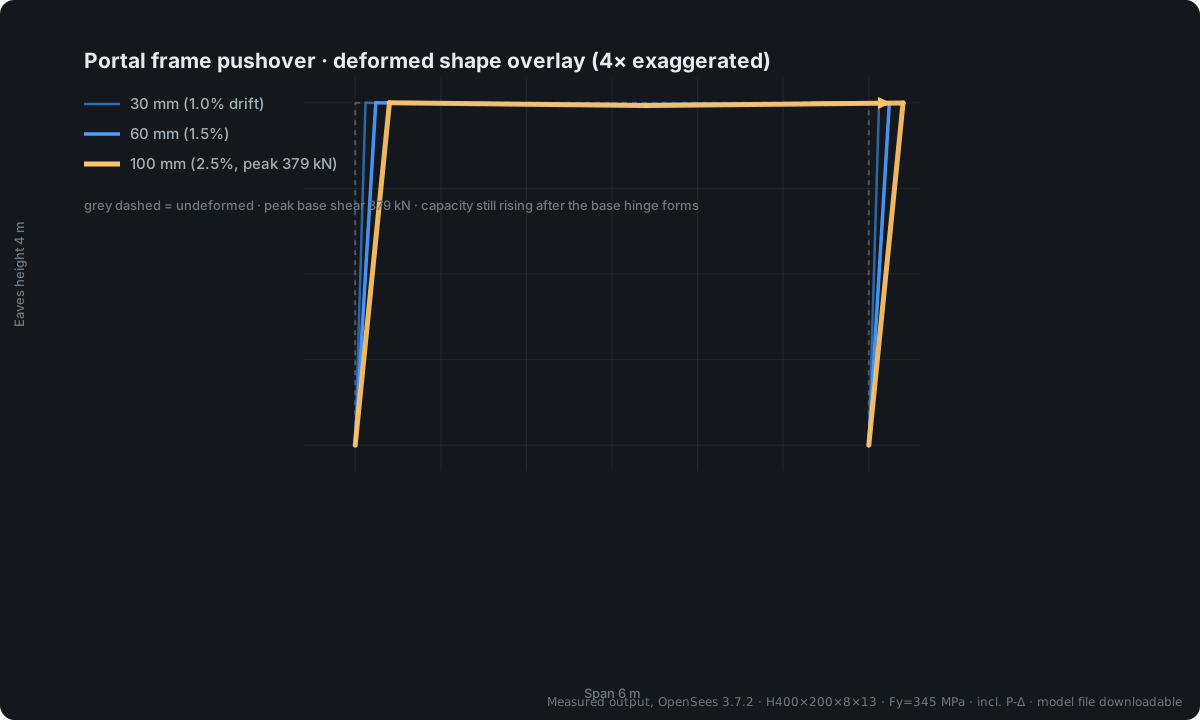
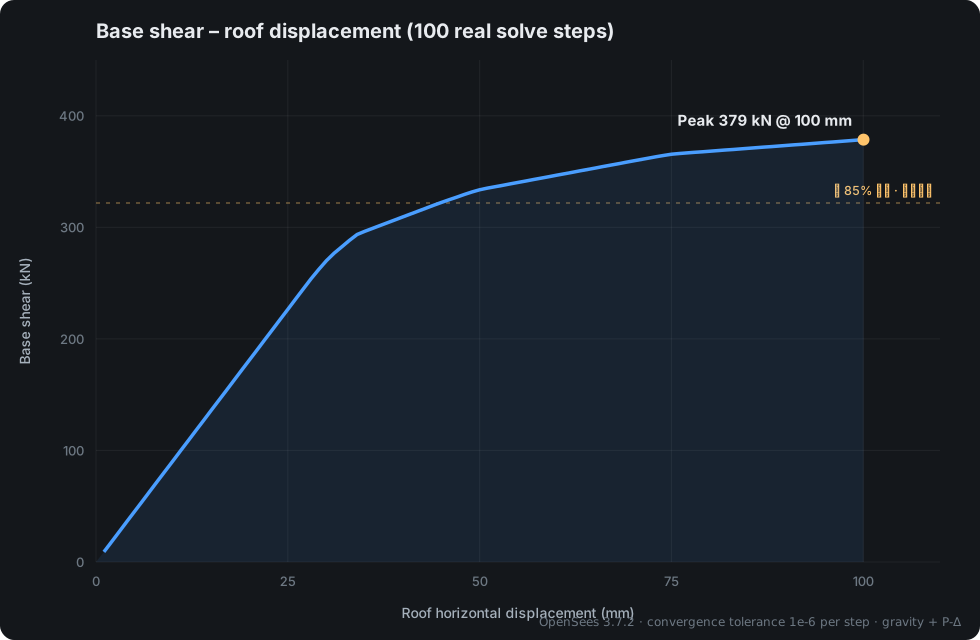
The most common structure type, used to see exactly what nonlinearity changes: after plastic hinges form at the column bases, capacity does not drop — it keeps rising. Elastic analysis cannot produce that part of the curve.
Model and settings
- Geometry
- Span 6.0 m · storey height 4.0 m
- Sections
- H400×200×8×13, fibre sections (web 10 fibres + flanges 4×2)
- Materials
- Steel01 · Fy = 345 MPa · E = 200 GPa · hardening ratio 0.015
- Elements
- forceBeamColumn × 4 · 5 integration points · columns include P-Δ
- Analysis
- Gravity (20 N/mm on the beam) + displacement-controlled pushover, 1 mm/step × 100 steps
- Convergence
- NormDispIncr 1e-6 · max 30 iterations · UmfPack
Key results
- Peak base shear379 kN
- Corresponding top displacement100 mm (2.5% drift)
- Onset of yieldingApprox. 35 mm (clear kink in the curve slope)
- Failure mechanismPlastic hinges at the column bases; beam ends unyielded
Runs as-is from the OpenSees 3.7.2 command line — no Kavvo needed to recompute it.
CASE-B
Four-storey two-bay steel frame · modal + pushover
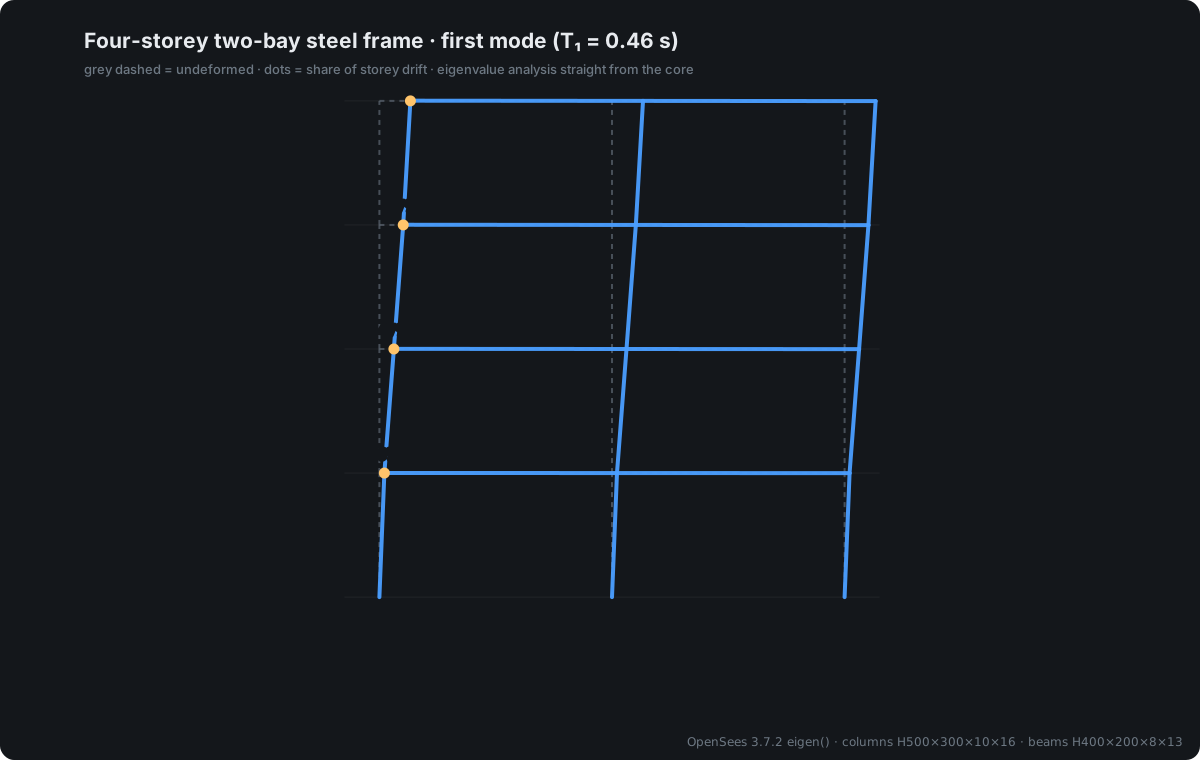
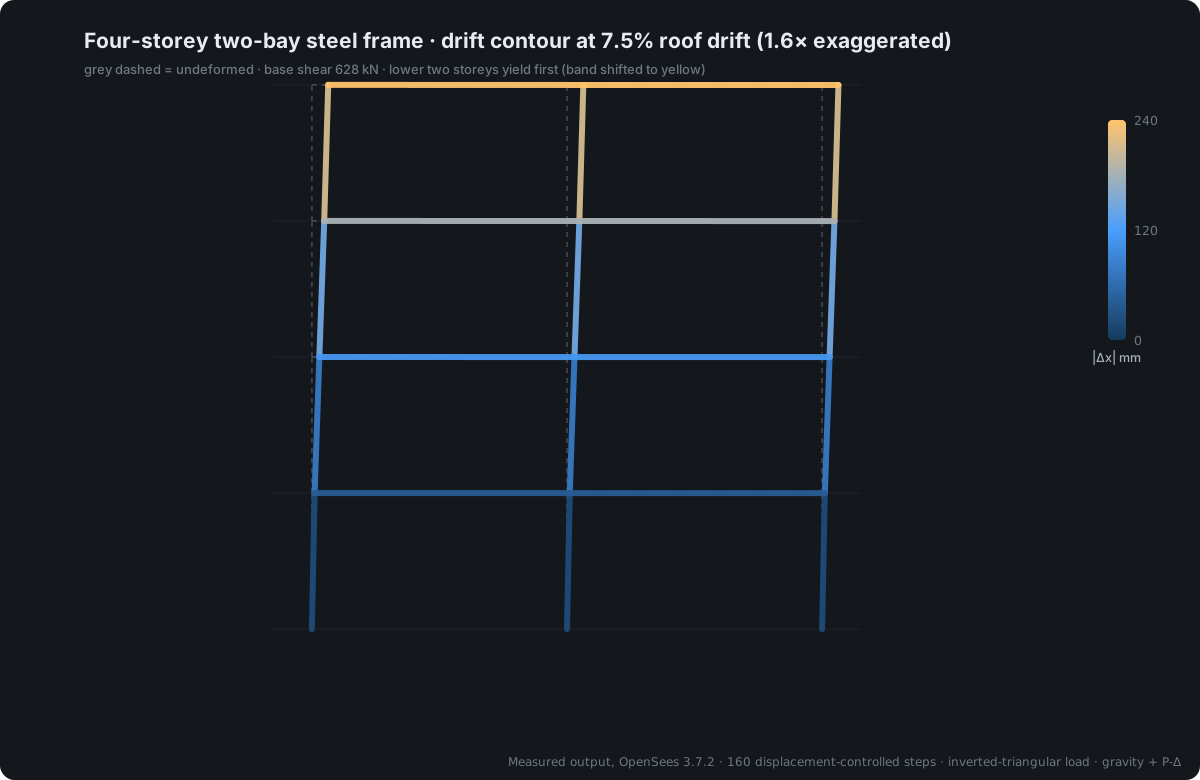
Dynamic properties and the overall yield mechanism, read together. The fundamental period sets the seismic demand; the inter-storey drift distribution shows where the weak storey is — both numbers are below, with no room for vagueness.
Model and settings
- Geometry
- 2 bays × 4 storeys · span 6.0 m · storey height 3.2 m
- Sections
- Columns H500×300×10×16 · beams H400×200×8×13 (all fibre sections)
- Materials
- Steel01 · Fy = 345 MPa · E = 200 GPa
- Elements
- forceBeamColumn × 20 · 5 integration points · with P-Δ
- Mass
- Lumped floor masses (equivalent to 245 kN on edge columns · 490 kN on interior columns)
- Analysis
- eigen(3) + displacement-controlled pushover under inverted triangular load, 1.5 mm/step × 160 steps
Key results
- Fundamental period T₁0.460 s
- 2nd / 3rd periods0.123 s / 0.055 s
- Base shear (7.5% drift)628 kN
- Yield mechanismBottom two storeys yield first, forming a global beam-hinge mechanism
Runs as-is from the OpenSees 3.7.2 command line — no Kavvo needed to recompute it.
CASE-C
Cantilever beam deflection · analytical comparison
The most basic verification: a member you can compute by hand from a formula, checking that the kernel returns the same number. If this step fails, none of the later nonlinear results are worth discussing.
Model and settings
- Geometry
- Cantilever 3.0 m · rectangular 200×400 mm
- Sections
- Elastic · A = 80,000 mm² · I = 1.0667×10⁹ mm⁴
- Materials
- E = 30,000 MPa (concrete-scale, linear elastic)
- Load
- Tip point load 10 kN
- Analytical
- δ = PL³/(3EI)
Key results
- ConclusionLinear-elastic deflection matches the analytical solution exactly
| Item | Computed | Analytical | Relative error |
|---|---|---|---|
| Tip vertical displacement | −2.8125 mm | −2.8125 mm | 0.0000 % |
| Section moment of inertia I | 1.0667×10⁹ mm⁴ | 1.0667×10⁹ mm⁴ | 0.0000 % |
Runs as-is from the OpenSees 3.7.2 command line — no Kavvo needed to recompute it.
Want to see how your structure checks out?
The current records cover 3 member classes (frame pushover / multi-storey frame / fundamental member verification) and will grow with releases. Kavvo holds no certification from any design code body or third-party institution; these numbers only demonstrate that the kernel produces these values on our models, and do not constitute a compliance statement.